


From Concept to a Launched Dementia-Care Platform in Under Five Months
$263K
Raised by Evva on WeFunder after launchCodeLaunch Atlanta
Won by Evva at the seed acceleratorUnder 5 Months
Concept to public launch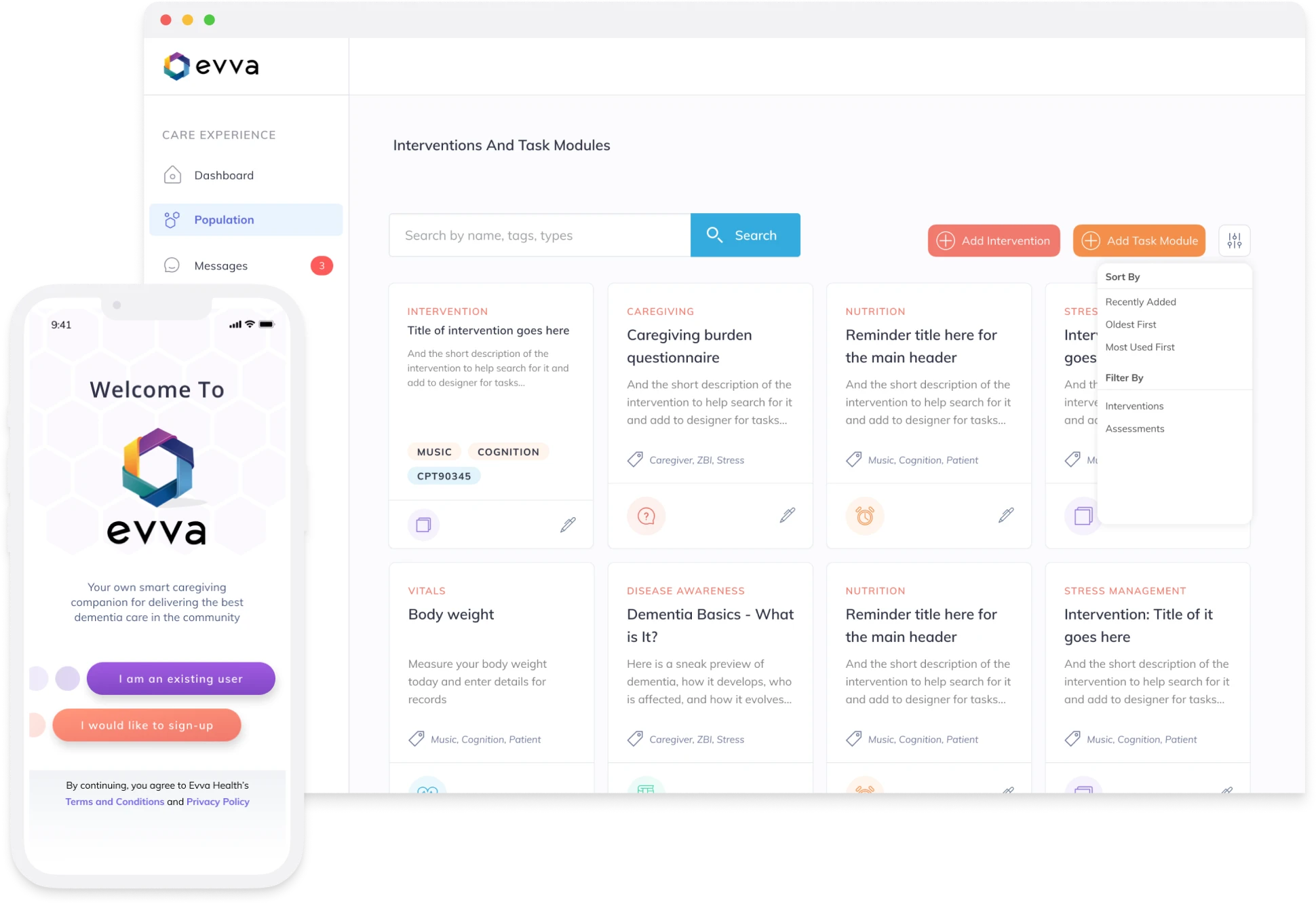
About Evva Health
- Geography
- United States
- Industry
- HealthTech
- Services
- HealthTech Software Development
Evva Health built care-coordination software for dementia in the United States. One diagnosis pulled in four groups: the person living with dementia, the family member carrying the daily care, the clinicians treating them, and the community services between visits. Each held a different part of the record, and the caregiver doing the most had the least clinical training.
SoluteLabs put all four on one record. It was a greenfield build, not a rebuild: product discovery, then UX and UI design, then full-stack delivery across web and mobile. The work ran from 2020 to 2021, reached public launch in under five months, and carried on for roughly six months past that launch.
“The expertise was impressive. We only had to talk to 1–2 people to take our requirements and they came back with amazing solutions. They captured our vision perfectly and they went above and beyond with their services.”
CEO & Co-Founder
Healthcare Tech Startup
Solution
SoluteLabs built the platform from scratch: product discovery first, then UX and UI design, then full-stack delivery across web and mobile. What came out was six surfaces over one record, so the family member doing the daily work, the clinician reviewing it and the community service filling the gaps each read the same picture at their own level of access.

Deliverables
Onboarding and Connected Records
- Setup began with the hive: the family, the clinicians and the community services around one person, invited onto one care team.
- Medications and supplements were managed on that same shared record rather than in a list somebody kept at home.
1upHealth Integration with Multiple EHR Systems
- Bi-directional Data Flow: Evva's product read from the clinical systems a member's providers ran, and wrote back to them
- Data Normalization: Whatever shape a system emitted was converted into one standard set of FHIR resources
- Historical Import: The relevant history came across in a single pass rather than being keyed in again
Conversations Across the Care Team
- One thread list carried both sides of the care team, the professionals working a case and the family around it, each labelled with their role.
- Threads were sorted by recency and filtered by location and care tier, so a coordinator could reach the right person rather than the last one.
- Photographs and files went into the thread itself, so what a caregiver saw at home reached the clinician who needed to see it.
The Daily Work, Prompted
- A medication prompt carried its instruction with it, not only the drug and the time, so whoever was on duty had what the last person knew.
- A scheduled visit opened from the same card that announced it, with the clinicians on the call named and the length shown up front.
- Routine care sat on the same timeline as clinical care, because for the family member doing the work they are one day.
Documents, and Who Could Open Them
- Powers of attorney, directives, living trusts, insurance cards and photo identification sat where the care team could reach them at the moment they were needed.
- A file stayed visible only to the members holding access to it, the member controlled that list, and the permissions could be changed at any time.
- A provider connection ran through an OAuth 2.0 flow, so access to the clinical systems was delegated and revocable rather than handed over as a shared password.
Tech Stack
React and Tailwind CSS built the admin panel and Flutter built the mobile applications, over a Nest.js and Hasura API layer on PostgreSQL. Firebase, OneSignal, Twilio and Postmark carried analytics, push, SMS verification and transactional mail. AWS, Docker and Cloudflare ran the hosting, and GitHub Actions and CodeMagic shipped the backend and the mobile builds.
React
- Admin panel framework
Tailwind CSS
- Styling
Flutter
- Mobile app framework
Nest.js
- Primary framework
Hasura
- CRUD APIs
PostgreSQL
- Database on RDS
Firebase
- Analytics and crash reporting
OneSignal
- Push notifications
Twilio
- SMS verification
Postmark
- Transactional email
AWS
- Hosting
Docker
- Containers
S3
- Object storage
Cloudflare
- Domain management and protection
GitHub Actions
- Backend CI/CD
CodeMagic
- Mobile CI/CD
SonarQube
- Code quality
Jira
- Project and test-case management
Google Docs
- Documentation
Google Meet
- Collaboration
Outcomes
SoluteLabs took Evva Health from a blank sheet to a public launch in under five months, and stayed with the platform for roughly six months after it.
Built from scratch, launched inside five months
There was no existing product to rebuild, so the platform was a greenfield build.
Product discovery ran first, then UX and UI design, then full-stack delivery.
Web and mobile shipped together, and the public launch came inside five months.
An engagement that ran from 2020 to 2021
The engagement ran from 2020 to 2021 and covered the whole of the build.
Work carried on for roughly six months past the platform's public launch.
Clinical data under consent, not under assumption
Evva's product exchanged data both ways with multiple record systems through 1upHealth.
What those systems emitted was normalised into one standard set of FHIR resources.
OAuth 2.0 consent and role-based access kept records to the authorised care-team roles.
Building a consumer health product that has to carry patients, family caregivers, clinicians and community services at once, under consent and role-based access?
That is the brief you just read: Evva carried people living with dementia, their families and their care teams on one platform, from concept to public launch. Let's talk about yours.


