Secure Voice-AI Agents for a Real-Time Pharmacogenetics Platform
Two outbound voice agents over telephony
NPI verified before any patient information is shared
Built and handed over in two months

Improving Patient Outcomes Through DNA-Driven Prescribing
- Geography
- United States
- Industry
- HealthTech
- Services
- HealthTech Software Development
A pharmacogenetics company working alongside Pharmacy Benefit Administrators (PBAs) to prevent adverse drug reactions. Its platform reads genetic data at the point of prescribing and returns treatment recommendations to the prescriber. Those decisions reach care teams and prescribing providers through fragmented channels, which delays denial notifications and pushes the follow-up onto administrative staff.
The client is under a non-disclosure agreement, so the company is not named on this page and no client figures appear on it. What follows is the architecture that was built and how it was delivered.
Challenges
Outbound calls had to verify the provider’s identity before sharing PHI or denial updates.
Outbound calls had to verify the provider’s identity before sharing PHI or denial updates.
Outbound calls had to verify the provider’s identity before sharing PHI or denial updates.
Outbound calls had to verify the provider’s identity before sharing PHI or denial updates.
Provider Authentication
Denial Communication
Knowledge Support
PGx Summaries
Provider Authentication
Outbound calls had to verify the provider’s identity before sharing PHI or denial updates.
Solution
We built two secure voice-AI agents for a pharmacogenetics platform working with PBAs. One to authenticate providers during outbound calls, and another to deliver denial notifications with API-powered alternatives, reinforced by RAG-driven insights from published studies.
- Voice agent
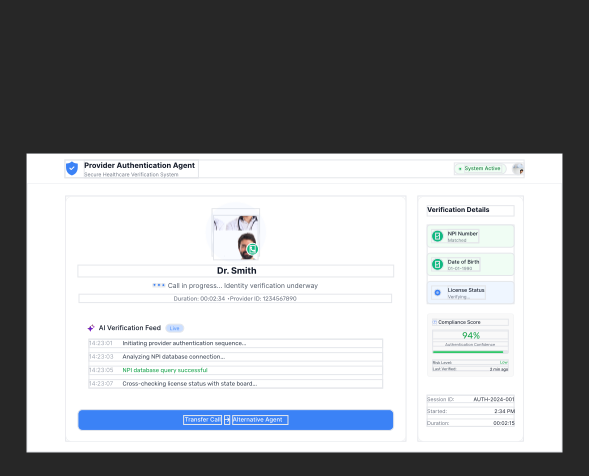
Places the call to the prescribing provider and asks them to confirm their NPI.
NPI verified. Only now is patient information shared.
- Voice agent
Delivers the denial and names an alternative returned by the platform.
- Provider
Responds on the line.
Explanations grounded in retrieval over published studies.
A representative call flow, not a recording.
Provider Authentication Agent
- Built a voice-AI agent to validate provider identity during outbound calls.
- Prevented disclosure of sensitive information until verification was complete.
- This agent then transferred the call to the second agent below.
Denial Notification & Alternatives Agent
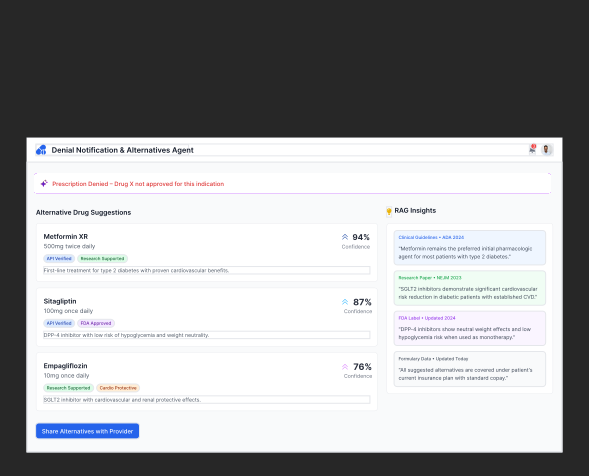
- Created a second voice-AI agent to proactively notify providers of drug denials.
- Delivered alternatives drawn directly from the platform APIs.
- Integrated RAG over research papers and white papers so the agent could cite published support for a denial and for its alternatives.
PGx Report Support
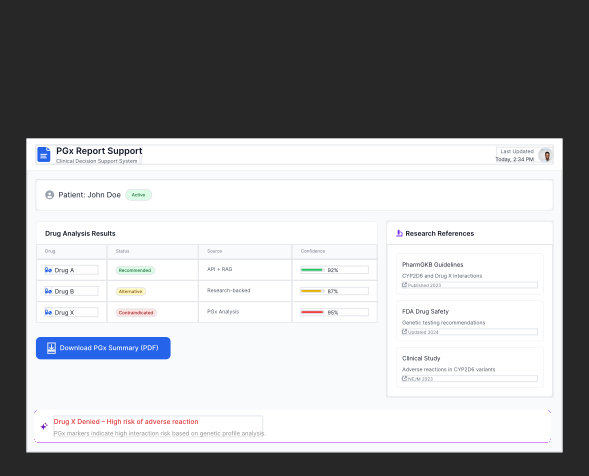
- PGx summaries were generated from the client’s existing tools.
- RAG surfaced relevant published studies and guidelines to reinforce and explain the denial and alternative recommendations.
Tech Stack
Twilio places the outbound call and ElevenLabs runs the voice loop, with reasoning, retrieval and the client's own PGx report APIs behind it. The build started on Dialogflow and moved to ElevenLabs for latency and inference reliability, a comparison that held at the time of the build and is not a standing verdict on either platform.
Call scheduled
Outbound call placed
Speech to text
Reasoning over retrieval
Text to speech
Provider responds
Twilio
- Outbound call transport
ElevenLabs
- Conversational voice platform, under a signed Business Associate Agreement
ASR
- Speech to text
VAD
- Voice activity detection, holding latency and compute down
TTS
- Text to speech
Gemini
- LLM
Claude
- LLM
Custom model
- Task-specific reasoning
Vector database
- Published studies and white papers behind the explanations
Tooling
- Function calls into the client's own APIs
PGx report APIs
- Provider lookup, report summary and report delivery
Post-call webhook
- Transcript handling after the call ends
NPI verification
- Runs before any patient information is disclosed
Zero data retention
- On the ElevenLabs platform
What the Two Agents Were Built to Do
Secure Communication
Outbound calls verified the provider's NPI before any patient information was shared.
Nothing sensitive was disclosed until that verification had completed.
Timely Notifications
The second agent placed the denial notification as an outbound call.
Alternative recommendations were drawn from the client's own platform APIs.
Knowledge-Backed Guidance
A retrieval path over published studies backed the explanations the agent gave.
Those references supported the denial and the alternative recommendations.
Building outbound provider communication that has to prove who is on the call before anything sensitive is said?
That is the brief you just read: two voice agents on a pharmacogenetics platform, one for identity and one for denial notifications with API-backed alternatives. Let's talk about yours.


