Agentic AI vs AI Agents: Which One Wins in 2025?
Karan Shah•10 Nov 25•8 Min Read
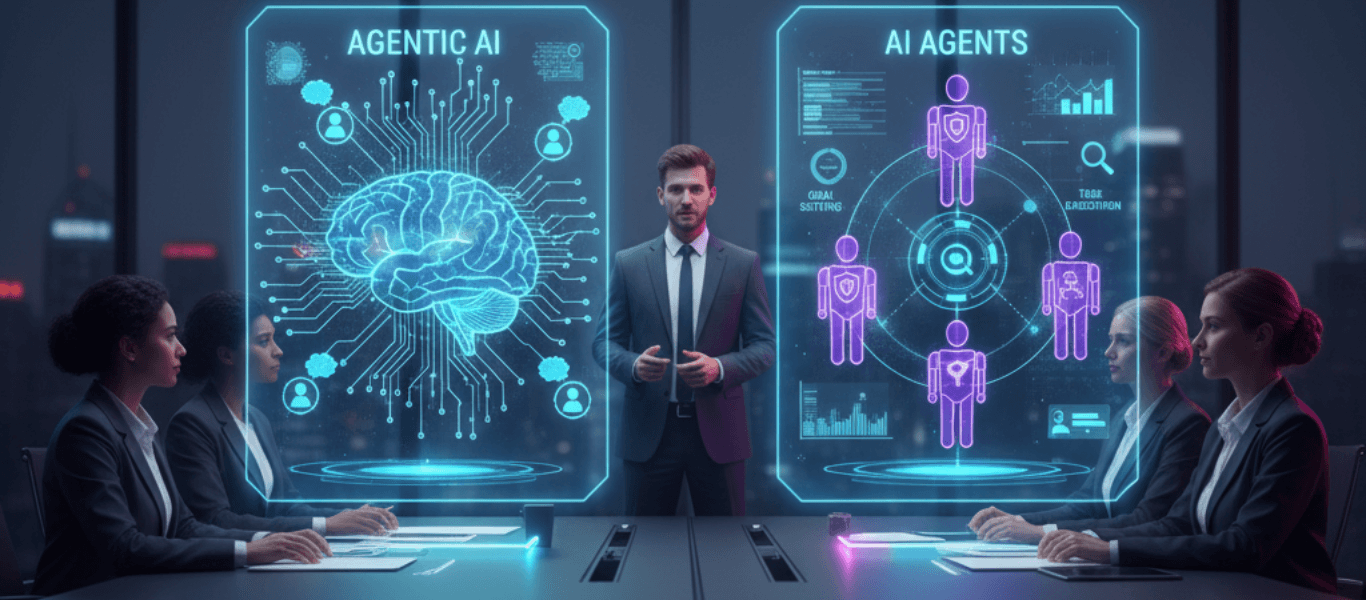
Artificial Intelligence lies at the center of a significant transformation in the way your company can do anything from simple automation to smart collaboration. Previously, AI agents were primarily applied for the automation of repetitive work; chatbots for customer support, digital assistants for calendar management, or bots for document handling. This "AI agent" philosophy delivered velocity and accuracy, but retained intelligence within contained, single-purpose systems.
Current times are very different. Agentic AI, the next generation of intelligent technology, enables multiple AI agents to collaborate towards shared objectives. These sophisticated systems don't merely automate; they interact, collaborate, and learn across various tasks and business areas. For businesses, this implies going beyond mere efficiency to driving genuine innovation and resilience in challenging settings. Instead of relying on siloed solutions, you benefit from intelligent networks that continuously learn, share information & provide dynamic support.
A recent McKinsey study found that organizations adopting agentic AI architectures report a 20–40% faster project delivery compared to those using traditional AI agents
This basic shift is important to your business, your customers, and the future of agentic AI in digital transformation. With Agentic AI, you're not merely adopting new technology. You're creating more intelligent, more resilient companies that make you competitive as technology continues to advance. If you want to remain competitive in a changing market, it's now crucial to understand and adopt Agentic AI.
AI Agents Explained
AI agents are smart software programs created to complete particular, well-defined activities on your behalf, usually without requiring your constant guidance. Essentially, they are independent digital workers programmed to do everything from responding to standard customer questions to managing documents or coordinating meetings.
What distinguishes AI agents is their capability to perform with a level of autonomy, accuracy, and consistency. Their fundamental principles are:
- Autonomy: They are able to decide and perform activities without direct human intervention, making you trust them to do work in the background.
- Task Specificity: Each AI agent is designed for a particular function, like responding to frequently asked questions via chatbots, managing appointment calendars as virtual assistants, or automating repetitive business tasks through RPA bots.
- Reactive Decision-Making: These agents notice variations in their world, work on new information, and respond rapidly to accomplish their set objectives.
Yet, AI agents do have their weaknesses, too. They will usually operate alone and can have difficulty responding outside their given parameters. Their intelligence is limited to the processes they were designed to accomplish, so they do not possess extensive contextual knowledge or the kind of adaptability necessary for more sophisticated, multi-step problem-solving. While they are best at dealing with repetitive or structured operations, they might need human assistance for anything unstructured or beyond their "comfort zone."
If your company depends on expert efficiency and dependability for particular tasks, AI agents provide a solid foundation. If you're looking toward the future, though, there's increasing value in seeking out solutions that bring bigger, more adaptive intelligence, something that Agentic AI promises to deliver.
What is Agentic AI?
Agentic AI definition is the next iteration in the evolution from AI agents to agentic AI, from standalone automation towards multi-agent orchestration in collaboration. Unlike stand-alone AI agents, which work separately, Agentic AI systems orchestrate multiple smart agents for collective goals, dynamically communicate & learn across various environments & workflows.

Key Features of Agentic AI
Agentic AI systems stand out because of their ability to act autonomously, collaborate intelligently, and adapt in real time to ever-changing business needs. These capabilities enable organizations to solve complex problems, streamline workflows, and provide personalized experiences even in dynamic environments.
- Collaboration: Rather than operating independently, every agent belongs to a network where information is shared, tasks are assigned, and objectives are aligned. This collaboration helps the system process intricate, multi-step challenges better.
- Shared Goals and Reasoning: Agentic AI architecture emphasizes end-to-end goals, integrating perception, planning, reasoning, and adaptive decision-making. The agents are able to decompose big tasks, formulate strategies, and revise plans when new data arises.
- Adaptive Learning: Through ongoing feedback, these systems adjust their methodology and performance for varying workflows, environments, or user requirements.
Core Components of Agentic AI
Agentic AI systems rely on several key components working together to create intelligent, adaptive behavior. These core parts enable the system to perceive its environment, reason effectively, take meaningful actions, and continuously improve.
- Perception: Agents actively gather and process real-time information from many sources, creating a rich decision-making context.
- Reasoning Engine: Agents utilize sophisticated logic and extensive language models to define goals, create plans, and resolve problems as a group.
- Action and Execution: Each agent not only acts for itself, but aids others, invoking software automation, handling external APIs, or even influencing physical devices.
- Learning and Adaption: Experience is constantly fed back into the system to enhance performance, gain more autonomy, and address new issues.
Real-World Examples of Agentic AI
Before barging into specific real-world applications, it’s essential to recognize how agentic AI vs AI agents translates into tangible business outcomes. By enabling multiple autonomous agents to work collaboratively, Agentic AI drives enhanced efficiency, agility, and decision-making across complex processes. This cooperative intelligence taps into new potentials that traditional AI agents working alone cannot deliver.
- Supply Chain: Procurement, logistics, and warehouse agents coordinate in real time, optimizing resources and timelines.
- Virtual Project Managers: Several agents are in charge of tasks, escalating problems, and offering proactive monitoring for smoother enterprise functioning.
- Smart Business Automation: Agentic AI manages workflows, assigns tasks, and enforces context-based updates across departments.
Agentic AI transforms how you manage complexity. By choosing solutions that connect autonomous agents, your organization can realize new opportunities for scalability, efficiency, and creativity.
Core Distinctions: AI Agents vs. Agentic AI
The difference between AI agents vs agentic AI represents a significant change in how companies coordinate tasks & drive innovation. When formulating contemporary automation plans, recognizing the difference between agentic AI and AI agents is essential to making the appropriate strategic moves.
| Aspect | AI Agents | Agentic AI |
|---|---|---|
Purpose | Perform well-defined tasks independently | Coordinate across various tasks and domains |
Intelligence Scope | Narrow and pre-defined | Broad, adaptive, and context-sensitive |
Communication | Operate in isolation | Collaborate and exchange information with other agents |
Decision Making | Rule-based or reactive | Strategic, goal-oriented, and emergent |
Learning | Static models | Continuous, cross-domain adaptation |
Architecture | AI agents architecture | Agentic AI architecture |
Example | Chatbot processing FAQs | AI team managing workflow automation |
By migrating from traditional AI agents to Agentic AI, you shift from task-specific automation to controlling entire systems that learn, adapt, and communicate. Agentic AI capabilities provide your business:
- Agile problem-solving for multifaceted goals, even as market conditions shift.
- Cross-departmental coordination that optimizes resource utilization and workflow effectiveness.
- Smarter decision-making through agents of data, context, and strategy sharing in real-time.
This dramatic shift is more than a technology upgrade; it's the basis of intelligent enterprise. Organizations embracing Agentic AI tap into the future where resilience, creativity, and data-driven decision-making are interconnected.
Agentic AI Architecture and Functional Model
Agentic AI architecture is created to allow intelligent systems to sense, reason, act, and coordinate well with complex tasks and environments. It comprises a number of salient layers that collaborate seamlessly for goal-oriented adaptive performance.
- Perception and Input Handling: The layer gathers information from multiple sources like APIs, sensors, and databases using NLP and computer vision for contextual understanding.
- Reasoning, Planning, and Communication Modules: This core translates input data into goals, formulates plans, and makes decisions. Communication protocols enable agents within the system to exchange information and coordinate their activities.
- Multi-Agent Coordination and Feedback Loops: Agentic AI constitutes multiple agents collaborating in a networked structure, handling task delegation and promoting effective cooperation and learning.
Interoperability is critical. API integration and live data streams are accommodated within the architecture, and agents are able to tap into current data and call upon specialized services. The Agentic AI systems ultimately move forward to self-organizing and adaptive goal management so that your business can manage complicated activities with ease.
Applications and Real-World Examples
Agentic AI examples across real-world industries demonstrate how smart networks are transforming processes and results.
- Business Process Automation: Blends procurement, logistics, and analytics agents handling orders, shipments, and analyzing data in real time.
- IT Operations: Monitors and remediates automatically, diagnosing problems and performing fixes with coordinated mechanisms.
- Customer Experience: AI-powered systems handle interactions through chat, email, and social media, increasing satisfaction and minimizing wait times.
- Healthcare: Coordinates diagnosis, medication logistics, and monitors patients, acting quickly and handling intricate workflows.
- Finance: Automated loan underwriting, risk decisioning, and compliance are supported by adaptive agents to enable more assertive, timely decisions.
These agentic AI capabilities exemplify the operational intelligence and flexibility realized by collaborative networks compared with conventional, siloed agents.
Why Agentic AI Matters?
Agentic AI vs AI agents is not just a technical difference; it's a matter of scalability, resilience, and adaptability in the competitive environment.
- Scalability: Agentic AI dynamically distributes tasks, efficiently managing increasing workloads.
- Resilience: Feedback loops and continuous learning enable rapid recovery and adaptation to new knowledge.
- Adaptability: Agentic systems, unlike legacy AI, adapt strategies in real time, maintaining businesses' nimbleness.
- Proactive Autonomy: Agentic AI independently sets goals and pursues outcomes instead of merely reacting to commands.
- Collaborative Intelligence: Multiple agents work together across domains, combining expertise and context for superior results.
- Continuous Learning: Unlike traditional AI agents, agentic AI constantly refines its strategies based on experience and feedback.
- Contextual Awareness: Agentic AI remembers situational details to inform smarter, personalized decisions.
Beyond automation, Agentic AI is the enterprise intelligence operating system, enhancing decision-making, accelerating innovation, and facilitating intelligent business processes through autonomous and networks that cooperate.
Challenges of Agentic AI
The adoption of Agentic AI brings new challenges and requires focus on ethics and governance.
- Data Privacy: Ubiquitous access to data necessitates stringent governance and consent practices to ensure user anonymity.
- Coordination Complexity: Autonomous agents bring a higher risk of miscommunication and emergent behavior, necessitating strong control structures.
- Risks of Emergent Behavior: Agents can create novel strategies, so proactive defenses are key.
Ethical Practices of Agentic AI
Here are some of the ethical practices of Agentic AI:
- Accountability: Well-defined responsibilities for the outcomes.
- Explainability: Clear systems to build trust.
- Human-in-the-loop governance: Preserving oversight to step in if risks occur.
Responsible deployment is based on guardrails, periodic audits, unbiased, inclusive checks, and adherence to regulations, ensuring agentic AI vs traditional AI upholds societal trust.
The Evolution and Future of Agentic AI
Evolution from AI agents to agentic AI has progressed from rule-based systems to generative models, now reaching an agentic ecosystem. Initial systems were rigid and single-minded, but agentic AI vs generative AI involves autonomous networks that adapt, collaborate, and optimize.
Looking Ahead:
- Autonomous enterprise orchestration will make end-to-end management of all business processes possible.
- Self-evolving agent networks will constantly develop their coordination and problem-solving capabilities.
- Cross-organization sharing of intelligence will fuel collaborative innovation across sectors.
- Areas of research such as alignment of agentic AI, safety protocols, and adaptive reasoning will guarantee dependability and trust.
- SoluteLabs is at the forefront of crafting future-proofed agentic AI solutions, enabling organizations to evolve and prosper.
Also Read: Top Generative AI Trends to Watch for in 2025
Conclusion
The distinction is obvious; whereas task automation was sufficient in the past, the intelligent collaboration of today raises new standards for tackling complex issues and fueling innovation. Agentic AI unites technology & human creativity, enabling realistic decision-making, ongoing learning, and collaboration throughout the business.
Companies entering the age of intelligence networks are endowed with agility, efficiency & opportunities that would otherwise remain out of reach from siloed automation alone. Agentic AI outlined the next stage, introducing interconnected, adaptive intelligence with the capacity to revolutionize every aspect of your operations.
Ready to transform from automation to intelligent collaboration? Get in touch with SoluteLabs today to begin your Agentic AI journey.

Agentic AI vs AI Agents: Which One Wins in 2025?