

Unifying a Fortune 500 Retailer's Knowledge with a Multi-Agent AI Platform
2,800+
Stores. The retail floor this knowledge platform had to reach.10K+
Documents, citation-backed, across mixed formats and languages.~15s
Answers, down from the five to ten minutes associates spent searching.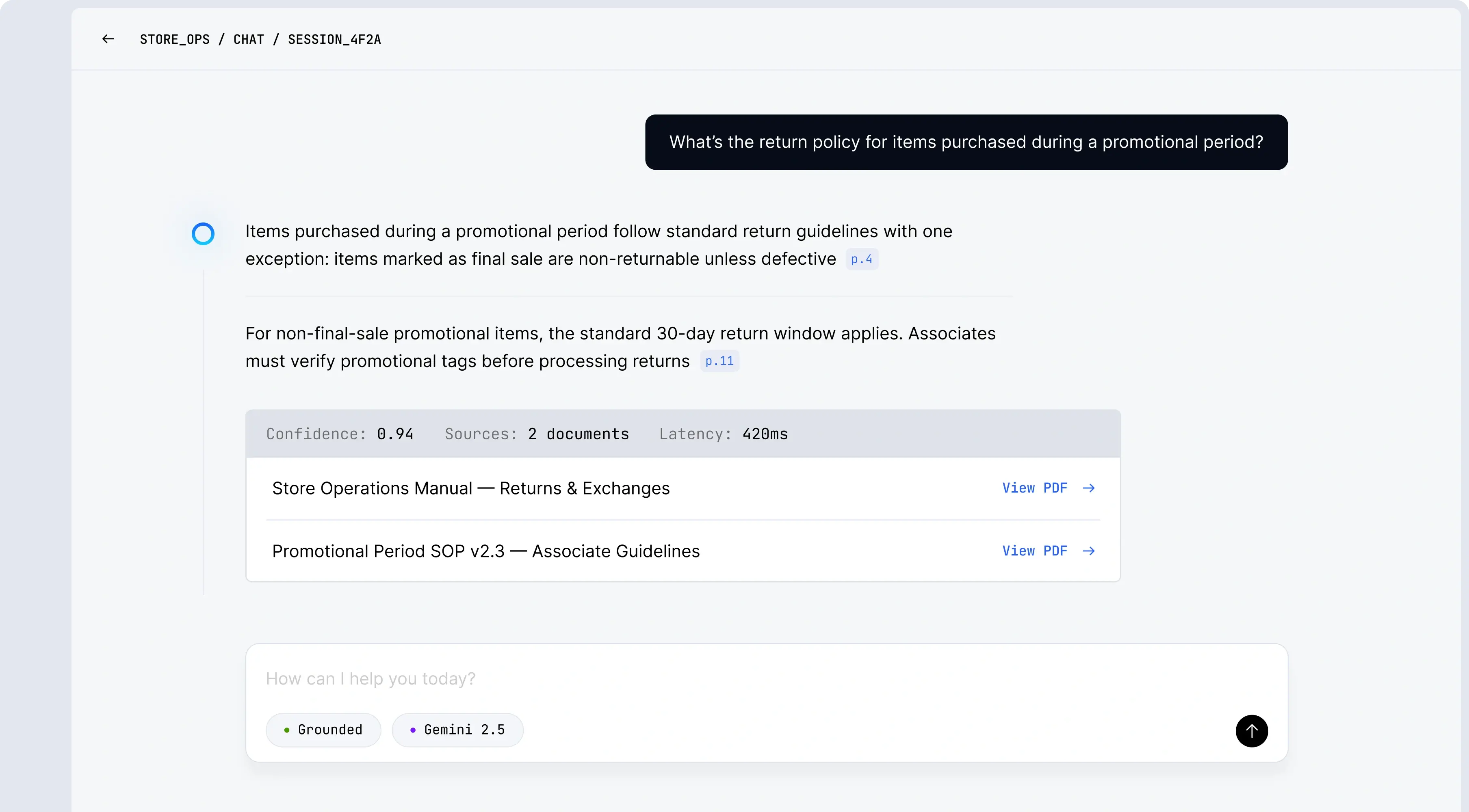
About this engagement
- Industry
- Retail
- Footprint
- 2,800+ stores
- Timeline
- six months
A confidential Fortune 500 retailer operating 2,800+ stores across 110+ countries needed one way to query three disconnected systems: documents, analytics, and loyalty. Store associates, regional managers, and loyalty teams each worked around the gap by hand.
Four engineers spent six months on discovery, a RAG knowledge platform, and multi-agent orchestration on top of it. We wrapped the systems already in place rather than rebuilding them. The product answers store, loyalty, and document questions in one conversational interface.
Solution
The RAG platform was already live when the agent work started, so we wrapped it rather than rebuilt it. First we made 10K+ documents citation-backed and queryable; then we put domain agents on top of that platform, behind one conversational interface.
Built on Google Cloud as a Google Cloud partner: Vertex AI for embeddings, Gemini for generation, and the Agent Development Kit for the agents. The patterns themselves are cloud-agnostic, with production experience on AWS and Azure. Arc ships as DEMO after a deliberate six-week-delay scope call, rather than delaying the agent release for one live integration. When the system is not confident enough, it does not answer.
Citation-backed knowledge search
Domain agents on one interface
Architecture
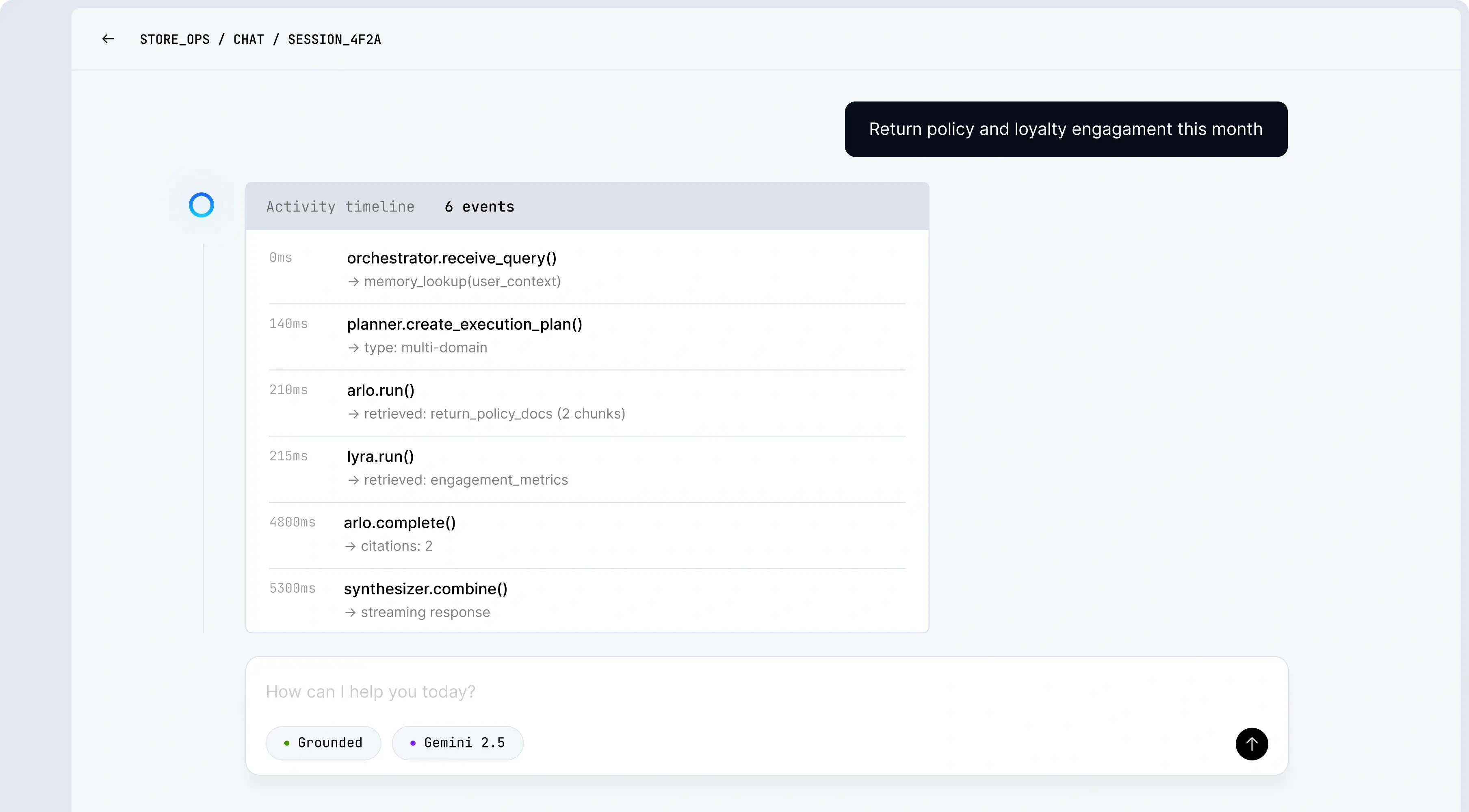
One request path. The associate asks, the orchestrator plans, domain agents answer over A2A against the systems already in place, and the synthesizer streams one cited answer back. Session memory sits beside the orchestrator; every hop is traced.

Deliverables
RAG knowledge platform
- Ask in plain words, in any language, and get an answer from the documents that already exist.
- Every answer names its source: the file, the page number, and a signed link to the original document.
- When the platform is not confident enough, it says so instead of guessing.
- A new upload is searchable in minutes, not after the next bulk import.
Multi-agent orchestration
- Arlo (Store Ops) is LIVE, Lyra (Loyalty) is LIVE, Arc (Analytics) ships as DEMO by a deliberate scope call.
- The live RAG platform was wrapped with a thin A2A proxy, with no backend changes.
- One question can fan out to several agents and come back as one answer.
- A memory layer keeps implicit context, such as which store the user is in.
Edge cases we handled
What production surfaced that the demo did not
Follow-up questions against a stateless API
Session memory in Redis carries the implicit context (which store, which query came before), so the orchestrator resolves a follow-up without the user restating anything.
A planner that was right four times in five
Plans are validated against a schema before execution and retried on failure. 12+ prompt iterations took first-try success to about 80%; the rest run a slower deterministic path instead of failing.
An agent down mid-query
The orchestrator returns the partial result with an explicit note on which domain is missing, rather than a timeout. Dropped streams reconnect with exponential backoff.
Answers nobody could verify
Generic responses failed immediately in real workflows. Every answer now carries the source file, page number and a signed link to the original, and citation logs show what the system was confident about.
Loyalty PII inside an orchestrated system
PII never enters the orchestrator; only the loyalty agent touches it, through its own API. Signed URLs expire in 15 minutes, IAM is scoped per service, and secrets live in Secret Manager.
Adding an agent without touching the orchestrator
Agents register with standardized metadata and are discovered at runtime. The live RAG platform became an agent through a thin A2A proxy, with no backend change.
Knowing why an answer happened
Every agent interaction is traced with OpenTelemetry and Cloud Tracing and logged to BigQuery, so any answer can be followed back through every step that produced it.
Outcomes
The before and after is the live table, told as three cards. No platform metric was invented to fill a fourth.
Answers in seconds, not minutes
Store associates spent 5-10 minutes finding an answer.
The same query now returns in about 15 seconds.
A citation-backed knowledge base, from nothing
Searchable documents started at zero.
The platform now covers 10K+ documents with page-level citation tracking.
One interface instead of three or four tools
A cross-domain answer used to take 3-4 tools.
Store, loyalty, and document questions now land in one conversational interface.
Talk to Us About Your Architecture
We will look at the systems you already run and show where a multi-agent layer actually earns its keep. Let's talk about yours.


